Materials & Making
Choosing Wool Fill for Small Textile Projects: A Closer Look at Holy Lamb Organics
A little stuffing can determine whether a handmade object feels buoyant or lumpy, softly yielding or stubbornly firm. Wool offers makers an appealing natural option—but its virtues, and its limits, depend on the fiber, its preparation, and the life the finished piece is expected to lead.
There is a moment in making a small textile object when the outside seems finished and the inside becomes the question. A cushion cover lies open on the table. A soft sculpture has taken shape, though not quite the shape intended. A stitched ornament is waiting for something to give it body. What goes inside may be hidden, but it will decide much of what the object becomes: how it sits in the hand, whether it holds a curve, how it recovers after being pressed, and what happens when it needs cleaning.
Wool is one candidate, with an old and persuasive set of associations: warmth, springiness, breathability, the tactile richness of animal fiber. For a maker, however, those associations are only the beginning. “Wool fill” can describe materials that differ in fiber length, cleanliness, density, processing, and intended use. A lofty wool batting designed for bedding is not automatically a practical choice for a small sewn ornament; a washable stuffing sold for toys may behave differently from a soft, loosely prepared fiber. The name of the material is not a specification.
Holy Lamb Organics offers a useful point of reference for thinking about wool in finished goods. Its product information describes wool used in bedding, including a crib mattress topper with wool batting and an organic cotton shell. That is informative as an example of material and construction, but it does not establish that the batting is sold or tested as a craft supply. Makers can learn from the details while keeping that distinction clear.
The character of wool fill
Wool fibers are naturally crimped, and that waviness helps give wool its resilience. In fill, resilience is the tendency to recover some loft after compression. A cushion that is briefly pressed and then regains its shape has a different character from one that stays flattened; a stuffed figure that must hold a rounded head or small limbs needs enough spring to resist collapsing without becoming rigid.
But resilience is not the same as firmness. A loose, airy fill can feel soft while still rebounding. A tightly packed fill can feel dense, even if the fiber itself is springy. The finished result depends on the material and the maker’s hand: how much is used, how evenly it is distributed, how small the opening is, and whether the seams constrain the contents. A sample made with a pinch of wool tells only part of the story. The same fiber can behave differently when packed into a narrow limb than when spread across a broad cushion.
Wool is also valued for managing moisture and temperature in particular applications. Those properties matter in bedding, where the material is used across a broad surface and in contact with a person over time. In a craft object, they may be less consequential than shape, washability, availability, or whether the fill migrates through the fabric. A material can have appealing natural properties and still be the wrong answer for a project that will be handled roughly or washed often.
There is, too, a sensory dimension. Wool may have a distinct scent, texture, or lanolin content depending on how it has been processed. Some makers welcome the natural feel; others prefer a more neutral, uniform stuffing. If an object is intended for a child, someone with sensitivities, or a recipient whose preferences are unknown, the fiber’s origin and processing deserve more than a passing glance. “Natural” is a description, not a guarantee that every person will find a material suitable.
What product details can—and cannot—tell you
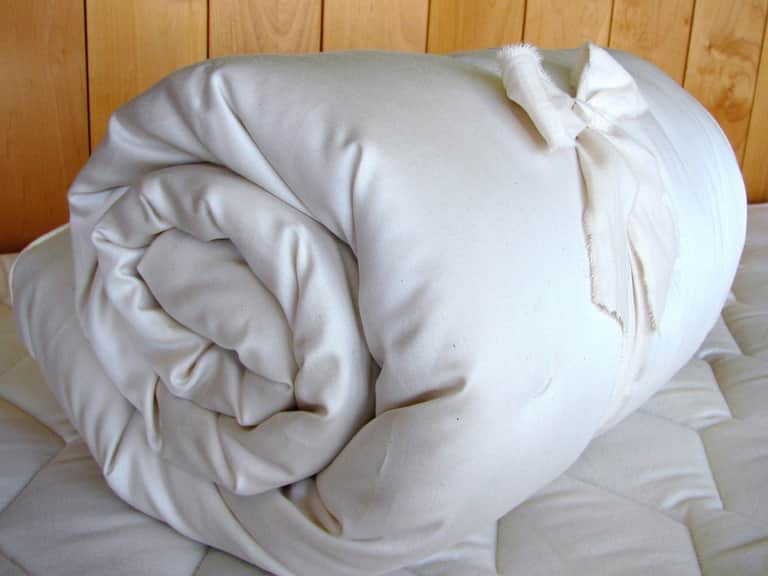
Holy Lamb Organics’ Certified Organic Crib Mattress Topper provides a concrete example of wool in a finished textile product. Its listed construction pairs GOTS-certified wool batting with a GOTS-certified organic cotton sateen shell. It is hand-tufted, and the product information gives a size, approximate depth, wool weight, and care guidance. These particulars are more useful than a general promise of softness because they describe what the material is doing in a specific object.
In that product, the wool batting is held within a cotton casing and secured by hand-tufting to help prevent shifting. This illustrates a practical principle for craft projects: fill does not act alone. The surrounding fabric, seam design, quilting, tacking, and overall dimensions all influence how the contents behave. A wool layer enclosed in a broad, stable casing is a different proposition from loose fibers placed inside a tiny, sharply shaped form.
The product’s care information is equally revealing, and equally specific to its intended use. The maker describes sunning to refresh, spot cleaning when possible, and a restricted approach to machine washing for large spills, followed by flat air-drying. That guidance should not be transferred wholesale to a handmade toy or cushion. The topper has its own scale, shell, construction, and use. A small project may have different seams, dyes, embellishments, or safety considerations, and its maker must determine suitable care for the complete object.
Certification also needs to be read with care. A certification reported for a particular product or material can help buyers understand standards relevant to that item. It does not mean every wool product from every source has the same certification, nor does it establish that a material is approved for an unrelated purpose. Check the exact listing, ask the supplier about the specific fill being offered, and avoid assuming that a bedding component is interchangeable with a craft-grade stuffing.
This is the useful boundary of a brand reference. A bedding product can demonstrate how wool and cotton are combined, how batting is stabilized, and how care instructions are communicated. It cannot, by itself, answer whether a particular fill is suitable for a miniature cushion, a soft sculpture, or a washable plaything. For that, the maker needs information about the material as sold and must test it in the project.
Start with the object, not the fiber
Before choosing a fill, describe the job it has to do. “I want a natural stuffing” is a preference; “this pincushion must stay compact and hold pins without distorting” is a design brief. A decorative cushion may call for loft and softness. A small fabric animal may need a balanced, even feel through a few narrow limbs. A soft sculpture might require distinct planes and a reliably held silhouette. These differences determine whether wool is promising and what form of wool might be worth testing.
- Loft: How much volume should the object have, and should the fill compress easily or retain a fuller profile?
- Firmness: Does the project need to yield under pressure, support weight, or remain fairly structured?
- Recovery: Will the object be squeezed, sat on, packed away, or handled repeatedly?
- Shape: Must the fill move freely, or should it stay evenly distributed in a particular contour?
- Cleaning: Will the finished object need frequent washing, occasional spot treatment, or only careful surface cleaning?
- Contact: Who will handle it, and are sensitivities, age, or intended use relevant?
The answers may point toward wool, but they may also point elsewhere. Polyester stuffing is widely available and often chosen for washable toys because some products can tolerate routine laundering; the label and construction still matter. Cotton batting can suit flatter, layered work, though it will not behave like a loose, springy stuffing. Kapok and other plant-based fills may have their own distinctive lightness, handling challenges, and sourcing considerations. No fiber wins every category. The right comparison is between specific materials for a defined object.
Preparation matters as much as origin
Wool may arrive as batting, roving, carded fiber, or another prepared form. The names indicate different arrangements of fibers, though suppliers’ terminology can vary. Batting is generally formed into a sheet or layer; it may be useful where a project calls for an even pad or a wrapped core. Loose stuffing or carded fiber is easier to distribute in a three-dimensional form, but can require patient teasing and careful packing. Roving, with fibers arranged in a long strand, may be suited to particular techniques but is not automatically convenient as general-purpose stuffing.
Ask what the material actually is, not only whether it is “wool.” Is it clean and ready to use? Has it been washed, carded, or blended? Is it intended for bedding, upholstery, felting, spinning, or stuffing? Has it been treated, and are any care or handling instructions available? These questions are ordinary due diligence, not a challenge to a seller. They help prevent a mismatch between a material’s original purpose and a maker’s plan.
Fiber length and preparation can affect how easily wool compacts, catches, or distributes. Very loose fill may be quick to shape but prone to unevenness if it is packed in handfuls. A dense layer may need to be cut or teased to fit a small cavity. If the outer cloth has a loose weave, short fibers can work through the fabric over time. A tightly woven lining or inner pouch can help contain fill, but adds seams and changes the object’s hand.
For a small project, begin with less fill than seems necessary. Separate it into small wisps and distribute them to the edges before adding more to the center. Use a blunt stuffing tool or the rounded end of a pencil for narrow spaces, taking care not to puncture the fabric or force fiber against a seam. Pause to massage the piece and check its outline. Overpacking is easy to do and surprisingly difficult to undo once the opening is sewn shut.
Test before committing
A short test can save an afternoon and a good length of fabric. Make a small sample from the same cloth, thread, and seam allowance planned for the final object. Fill it with a measured amount of wool, close it, and handle it as the finished project will be handled. Press it. Roll it. Leave it compressed briefly, then see whether it recovers. If washing is likely, test the complete sample according to a care method you can reasonably use for the final object.
For a sculptural project, a single flat sample may not answer the question. Try a small sphere, tube, or corner. These forms expose the ways fill gathers in tight spaces and reveal whether the material can support the silhouette. Record the amount used and the result. “A little more than a handful” is a charming workshop memory, but it is a poor repeatable specification.
Testing also helps distinguish a fill problem from a pattern problem. A lumpy finish can result from clumped fiber, but it may also come from a narrow seam allowance or an abrupt change in the shape of the cavity. A drooping form could be underfilled, overlarge, or made from cloth with too much give. The sample lets you alter one variable at a time rather than blaming the wool for every disappointment.
If the object is for a young child or another use where small parts, fiber release, or cleaning are significant concerns, do not rely on a home test as a substitute for applicable safety guidance. Check the relevant rules and standards for the intended market and use. Craft materials and finished products are not necessarily evaluated in the same way, and a carefully sewn project is not automatically suitable for every recipient.
Care is part of the design
Many makers choose materials first and write the care label later, as though washing were a footnote. It is better treated as a design constraint from the outset. A fill that must be kept dry may be a poor match for a frequently used kitchen cushion. A delicate outer fabric can limit cleaning even if its stuffing is robust. Surface embroidery, beads, dyes, and closures may also affect what the finished object can tolerate.
Wool’s care needs vary with fiber preparation and construction. Heat, agitation, moisture, and drying conditions can affect wool textiles, but the response depends on the material and how it has been processed. Never infer a washable setting from the word “wool,” and do not assume that guidance for a large bedding item applies to a smaller handmade piece. Follow the supplier’s instructions for the specific material, then consider whether the shell and embellishments can withstand the same treatment.
Where routine washing is important, the simplest solution may be a removable cover, a separately washable inner pouch, or a different fill. Where the object is mainly decorative, careful surface cleaning may be acceptable. The choice should be honest: a beautiful object with demanding care is still useful, but the recipient should know what it asks of them.
A practical buying checklist
When evaluating wool filling for textile crafts, gather information before buying a large quantity. A clear product description should tell you enough to judge whether a sample is worth trying. If it does not, ask questions or choose a supplier that can identify the material’s intended use.
- Confirm whether the product is loose fill, batting, roving, or another form.
- Check its stated intended use; do not assume bedding wool is marketed as craft stuffing.
- Ask about fiber composition, preparation, cleaning, and any treatments.
- Look for care instructions that address the material itself, not just a finished product made from it.
- Buy a small amount for a sample before planning a larger project around it.
- Consider the outer fabric, seams, lining, and intended recipient alongside the fill.
- Keep supplier details and care notes with the project so the finished object’s needs are not forgotten.
The quiet decision inside the seam
Filling rarely gets the attention of a color choice or a clever silhouette. It is usually concealed, doing its work without ceremony. Yet it is the part that makes a soft object feel convincingly soft, keeps a small form from sagging, or turns an appealing pattern into something pleasant to hold. Wool can bring spring, warmth, and a natural fiber character to that hidden structure. It can also bring particular sourcing, handling, and care questions that deserve a place at the worktable.
Holy Lamb Organics’ bedding information is useful not as a shortcut to a craft recommendation, but as a reminder to read material claims in context. A wool batting specified for a cotton-encased crib mattress topper tells a maker something about one carefully described construction. It does not settle the question of what belongs inside a miniature sculpture or a washable cushion. The distinction is not a discouragement. It is an invitation to test, ask, and choose with precision.
For the maker, the best fill is not necessarily the most luxurious, the most natural, or the most familiar. It is the one that suits the object’s shape, use, care, and intended life. That decision may be made in a few quiet minutes, with a scrap of cloth and a small sample of fiber. Later, when the finished piece keeps its form and feels right in the hand, the work inside the seam will have announced itself in the only way that matters.